
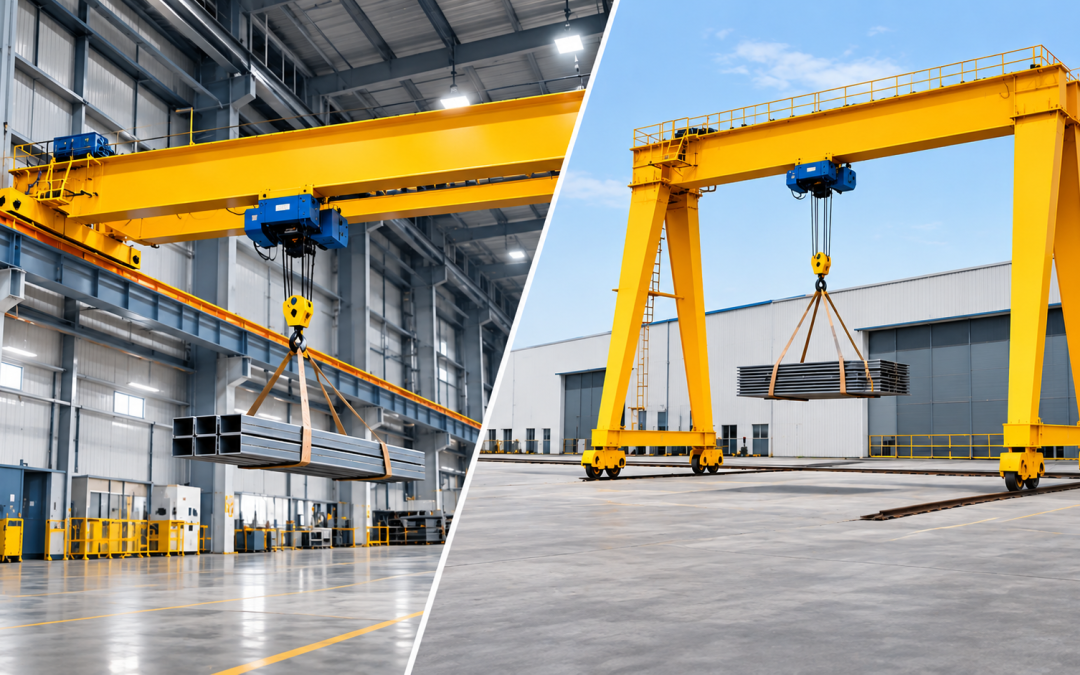
Choosing the right lifting equipment is an important decision for warehouses, manufacturing facilities and industrial operations. When handling heavy materials, machinery and large components, businesses need a lifting solution that suits their workspace, operational requirements and material handling processes.
Two commonly used industrial lifting systems are overhead cranes and gantry cranes. Although both are designed to lift and move heavy loads, they differ in structural design, installation requirements and applications.
So, when comparing an overhead crane vs gantry crane, which option is more suitable for your warehouse?
In this guide, we explore their key differences, advantages and applications to help you make a more informed decision.
What Is Overhead Crane?
An overhead crane, also known as a bridge crane, is a lifting system installed above a designated working area. It typically consists of parallel runway beams, a travelling bridge, a trolley and a hoist mechanism.
The bridge moves along the runway beams, while the trolley travels across the bridge. This allows the crane to lift and transport materials horizontally and vertically within its designated operating area.
Overhead cranes are commonly installed in facilities with suitable structural support, such as manufacturing plants, engineering workshops and industrial warehouses.
Common applications of overhead cranes:
- Manufacturing and production operations
- Heavy machinery handling
- Steel fabrication facilities
- Engineering workshops
- Industrial material handling
- Assembly and maintenance operations
One of the main advantages of an overhead crane is its ability to utilise the available overhead space without requiring additional floor-level supporting legs.
What Is a Gantry Crane?
A gantry crane is an industrial lifting system supported by legs that carry the crane structure. These legs typically travel along floor-mounted rails or wheels, depending on the crane design.
Unlike conventional overhead cranes, gantry cranes do not necessarily require building-supported runway structures. Their supporting legs allow them to operate independently of the building’s overhead structural system.
Gantry cranes are commonly used in outdoor storage yards, construction areas, manufacturing facilities and locations where installing a building-supported overhead crane may not be practical.
Common applications of gantry cranes:
- Outdoor material storage yards
- Construction and infrastructure projects
- Heavy equipment handling
- Manufacturing facilities
- Steel fabrication operations
- Loading and unloading areas
Depending on the configuration, gantry cranes can be designed for indoor or outdoor applications.
Overhead Crane vs Gantry Crane: Key Differences
Although both crane systems perform similar lifting functions, their structural designs and installation requirements are different.
Here are the main differences to consider.
A. Structural Design
Overhead Crane
An overhead crane operates using a bridge structure supported by elevated runway beams. The system is generally integrated into the building’s supporting structure or a purpose-designed runway support system.
Gantry Crane
A gantry crane features supporting legs that carry the bridge structure. These legs transfer the crane loads to the supporting floor, rails or foundation.
B. Installation Requirements
Overhead Crane
Installation typically requires suitable building structures or independently engineered runway supports to accommodate the crane loads.
Before installation, the building structure and runway support system must be assessed for suitability.
Gantry Crane
Gantry cranes require a suitable supporting surface or foundation for their wheels or rails. They may be considered where existing building structures are unsuitable for supporting an overhead crane.
C. Floor Space Requirements
Overhead Crane
Since the main crane structure is supported above the working area, overhead cranes can help preserve floor space for production, storage and other activities.
Gantry Crane
Gantry cranes use supporting legs that occupy floor space. The movement path and supporting arrangement should be considered when planning the facility layout.
D. Mobility and Movement
Overhead Crane
The bridge travels along fixed runway beams, while the trolley moves across the bridge. This allows materials to be transported within a defined working area.
Gantry Crane
Depending on its design, a gantry crane can travel along floor-mounted rails or use wheels for movement. Some configurations are designed to be repositioned between different working areas.
E. Suitable Working Environments
Overhead Crane
Often suitable for indoor industrial environments with appropriate structural support, such as factories, warehouses and engineering workshops.
Gantry Crane
Suitable for various indoor and outdoor environments, particularly where independent supporting legs provide a practical installation arrangement.
Comparison Table: Overhead Crane vs Gantry Crane
| Comparison | Overhead Crane | Gantry Crane |
|---|---|---|
| Main structure | Bridge supported by elevated runways | Bridge supported by legs |
| Building support | Requires suitable runway support | Does not necessarily require building-supported runways |
| Floor space | Generally keeps the floor area more open | Supporting legs occupy floor space |
| Movement | Travels along fixed runway beams | Travels on rails or wheels, depending on design |
| Common location | Factories and indoor warehouses | Indoor and outdoor facilities |
| Installation | Requires structural and runway assessment | Requires suitable floor, rails or foundation |
Both systems can be engineered for different lifting capacities and operational requirements. The most suitable option depends on the facility’s layout, structural conditions and intended application.
Advantages of Overhead Cranes
Overhead cranes offer several advantages for industrial facilities that require regular material handling.
• Better Floor Space Utilisation
By operating above the working area, overhead cranes help minimise the need for floor-level supporting structures within their travel path.
• Efficient Material Movement
The bridge and trolley mechanisms allow materials to be transported across a designated working area, supporting production and warehouse operations.
• Suitable for Heavy-Duty Applications
Overhead cranes can be engineered for different lifting capacities, making them suitable for handling heavy machinery, steel components and industrial materials.
• Integration with Industrial Operations
Overhead crane systems can be incorporated into manufacturing workflows, assembly areas and material handling processes.
Advantages of Gantry Cranes
Gantry cranes also offer practical benefits depending on the working environment.
• Independent Supporting Structure
Gantry cranes have their own supporting legs, which can reduce reliance on the building’s overhead structural system.
• Flexible Installation Locations
They can be suitable for indoor or outdoor operations, depending on their design and environmental requirements.
• Suitable for Open Working Areas
Gantry cranes can be useful in locations such as storage yards, construction sites and industrial areas where a dedicated runway structure may not be available.
• Different Configuration Options
Gantry cranes are available in different configurations, including full gantry and semi-gantry arrangements, to suit different facility requirements.
How to Choose the Right Crane for Your Warehouse?
Selecting between an overhead crane and a gantry crane requires more than comparing their structural designs.
Here are several factors to consider before making a decision.
1. Warehouse Structure
Assess the building’s structural capacity, available headroom and suitability for supporting an overhead crane runway system.
If the building cannot accommodate the required support structure, a gantry crane may be worth considering.
2. Lifting Capacity
Identify the maximum weight of the materials that need to be lifted. The selected crane must have an appropriate rated lifting capacity for the intended application.
3. Working Area and Layout
Consider the available floor space, crane travel path, operating area and potential obstructions within the facility.
4. Lifting Height and Span
Determine the required lifting height and horizontal travel distance. These measurements will influence the crane configuration and installation requirements.
5. Indoor or Outdoor Application
Consider the working environment, including exposure to weather, dust, temperature and other environmental conditions.
6. Maintenance and Long-Term Requirements
Evaluate the maintenance accessibility, inspection requirements, operational frequency and availability of technical support.
A professional assessment of these factors can help determine the most suitable crane system for your facility.
Which Is Better: Overhead Crane or Gantry Crane?
There is no single answer because both crane systems are designed for different operational requirements.
An overhead crane may be a suitable choice for warehouses and manufacturing facilities that have appropriate structural support and require efficient material movement across a fixed working area.
A gantry crane may be more suitable for facilities that require an independent supporting structure, particularly in open working areas or locations without suitable overhead building support.
Ultimately, the right choice depends on your lifting requirements, facility layout, installation conditions and long-term operational needs.
Looking for an Overhead Crane System for Your Facility?
Selecting the right industrial lifting equipment can make a difference in how your warehouse or manufacturing facility manages daily material handling operations.
At Powertechnic, we provide industrial lifting solutions, including Overhead Crane Systems, to support different material handling requirements.
Whether you are planning a new installation or looking to improve your existing lifting operations, our team can help you explore a suitable solution based on your facility’s requirements.
Disclaimer
We hope you found this article helpful and informative. Please note that the content provided is for general informational purposes only and should not be construed as professional advice. It may not reflect the full scope of services offered by Powertechnic Handling Equipment (M) Sdn. Bhd.
For tailored guidance, we strongly recommend consulting with a qualified industry professional. To receive expert advice and crane recommendations specific to your project requirements, please reach out directly to our team.
While we strive to ensure the accuracy and completeness of the information shared in our blog posts, Powertechnic Handling Equipment (M) Sdn. Bhd. makes no warranties and assumes no responsibility for any errors, omissions, or outcomes arising from the use of this content.