
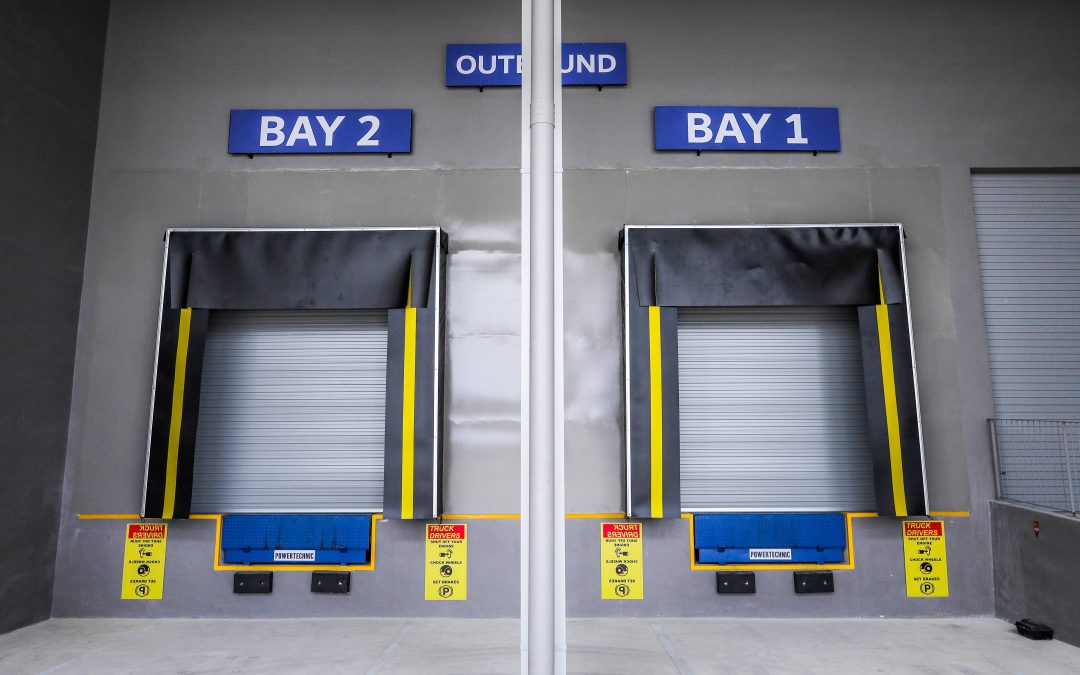
If dock levellers handle the height gap between warehouse and trailer, dock shelters and seals handle everything around it — the weather, the dust, the temperature swings, and the energy bill nobody wants to talk about. They’re easy to overlook, but the wrong (or missing) shelter can quietly cost a facility thousands a year.
What Are Dock Shelters and Seals?
Both sit at the loading bay opening and close the gap between the building and the trailer once it’s backed in, but they work differently.
Dock seals are foam-filled pads mounted around the door frame that compress against the sides and top of the trailer, forming a tight seal on contact.
Dock shelters are flexible curtains or frames — often fabric or vinyl — that extend outward and wrap around the trailer, creating an enclosed tunnel between the building and the vehicle.
The Main Types
Foam dock seals are the simplest and most affordable option, well-suited to facilities with a fairly standard, consistent range of trailer sizes.
Inflatable dock seals use an air bladder that expands after the trailer parks, adapting to a wider range of trailer sizes and shapes for a tighter fit.
Curtain-style shelters use flexible fabric panels that flex around irregular trailer shapes, ideal for facilities handling mixed fleets.
Rigid-frame shelters use a fixed frame with a curtain face, offering more structure and durability for high-traffic docks.
Why They’re Worth the Investment
- Energy efficiency — An open gap around a trailer can leak conditioned or heated air constantly during loading, driving up utility costs significantly over a year.
- Product protection — Sensitive goods (food, pharmaceuticals, electronics) are exposed to outside temperature and humidity every time a trailer door opens without a seal.
- Weather protection — Rain, snow, and wind blowing straight into the warehouse during loading isn’t just uncomfortable for workers — it can damage goods and create slip hazards.
- Pest and dust control — A sealed opening keeps insects, rodents, and airborne debris from finding their way into storage areas.
Choosing the Right One
Trailer variety is the biggest factor. Facilities receiving the same fleet or standardized trailers do fine with foam seals. Mixed fleets with irregular trailer heights and widths benefit from inflatable seals or curtain shelters that flex to fit.
Climate matters too — colder regions get the most value from tight, well-insulated shelters, while facilities storing temperature-sensitive goods should treat sealing as essential rather than optional.
Maintenance Basics
- Inspect foam pads and curtains for tears, compression damage, or mildew.
- Check inflatable seals for air leaks and proper inflation.
- Replace worn seals promptly — a damaged seal often leaks more than no seal at all, since it holds the trailer at a gap without closing it.
- Keep frames and mounting hardware free of rust and corrosion.
The Bottom Line
Dock shelters and seals don’t get much attention until an energy bill spikes or a shipment arrives damaged. Paired with a good dock leveller, they turn a loading bay from an open gap in the building envelope into a controlled, efficient transition point — which is exactly what a well-run facility needs.
Disclaimer
We hope you found this article helpful and informative. Please note that the content provided is for general informational purposes only and should not be construed as professional advice. It may not reflect the full scope of services offered by Powertechnic Handling Equipment (M) Sdn. Bhd.
For tailored guidance, we strongly recommend consulting with a qualified industry professional. To receive expert advice and crane recommendations specific to your project requirements, please reach out directly to our team.
While we strive to ensure the accuracy and completeness of the information shared in our blog posts, Powertechnic Handling Equipment (M) Sdn. Bhd. makes no warranties and assumes no responsibility for any errors, omissions, or outcomes arising from the use of this content.