
Efficient material handling is essential for maintaining productivity and smooth operations in warehouses and industrial facilities. As businesses handle heavier materials, larger inventories and more complex operations, having the right lifting equipment becomes increasingly important.
One of the most widely used lifting solutions in industrial environments is the warehouse crane. Designed to lift, move and position heavy loads, warehouse cranes help businesses handle materials more efficiently while making better use of their available workspace.
But what exactly is a warehouse crane, what types are available, and how do you choose the right system for your facility?
Let’s explore everything you need to know.
1. What Is a Warehouse Crane?
A warehouse crane is a mechanical lifting system designed to move heavy materials, equipment and goods from one location to another within a warehouse or industrial facility.
Unlike forklifts and other mobile material handling equipment, certain warehouse crane systems operate using overhead structures, allowing materials to be lifted and transported without occupying valuable floor space.
Warehouse cranes are commonly used in manufacturing plants, distribution centres, logistics facilities, engineering workshops and other industrial environments.
Depending on the operational requirements, warehouse cranes can be designed with different lifting capacities, configurations, spans and operating mechanisms.
2. Different Types of Warehouse Cranes
There are several types of warehouse cranes available, each designed for specific lifting requirements and working environments.
A. Overhead Crane
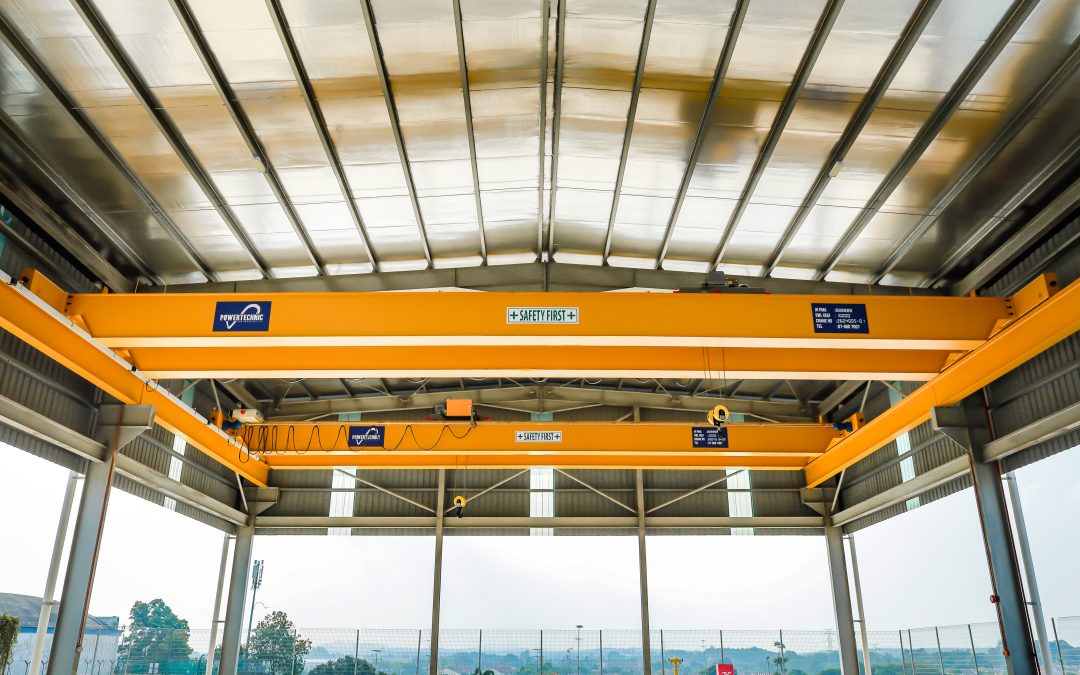
An overhead crane, also known as a bridge crane, is a lifting system installed above the working area. It typically consists of parallel runways, a travelling bridge and a hoist mechanism.
The crane moves loads horizontally along the runway and across the bridge, allowing materials to be transported throughout a designated working area.
Common applications:
-
Manufacturing and production facilities
-
Heavy machinery handling
-
Engineering workshops
-
Steel fabrication facilities
-
Industrial warehouses
Overhead cranes are suitable for facilities that require frequent lifting and movement of heavy materials within a fixed working area.
B. Gantry Crane
A gantry crane is a lifting system supported by legs that move along floor-mounted tracks or wheels, depending on its configuration.
Unlike conventional overhead cranes, gantry cranes do not necessarily require an existing building runway structure for support.
Common applications:
-
Outdoor storage yards
-
Construction sites
-
Manufacturing facilities
-
Heavy equipment handling
-
Loading and unloading operations
Gantry cranes are useful for applications where an overhead supporting structure is unavailable or where a mobile crane configuration is preferred.
C. Jib Crane
A jib crane consists of a horizontal arm, known as a jib, which supports a hoist for lifting and moving materials within a defined working radius.
It can be mounted on a wall or supported by a freestanding column.
Common applications:
-
Assembly workstations
-
Production lines
-
Maintenance areas
-
Machinery loading and unloading
-
Small industrial workspaces
Jib cranes are particularly useful for repetitive lifting tasks within a specific workstation or production area.
D. Monorail Crane
A monorail crane operates along a single fixed overhead track, allowing materials to move along a predetermined route.
It is commonly integrated into production processes where materials need to travel between specific workstations.
Common applications:
-
Manufacturing production lines
-
Assembly operations
-
Material transfer systems
-
Industrial processing facilities
Monorail cranes can help streamline repetitive material movement along established production routes.
3. How Does a Warehouse Crane Work?
Although different crane systems have different configurations, most warehouse cranes operate using a combination of lifting and travelling mechanisms.
The general operating process involves:
Step 1: Load Attachment
The operator positions the lifting device, such as a hook or suitable lifting attachment, to secure the load.
Step 2: Vertical Lifting
The hoist mechanism lifts the material vertically to the required height.
Step 3: Horizontal Movement
Depending on the crane configuration, the load can be moved horizontally across the working area using travelling mechanisms.
Step 4: Load Positioning
The operator carefully positions and lowers the material at the designated location.
These movements allow warehouse cranes to transport materials efficiently across designated working areas.
4. Key Benefits of Using Warehouse Cranes
Installing the right warehouse crane system can provide several operational advantages.
Improved Material Handling Efficiency
Warehouse cranes allow operators to lift and transport heavy materials more efficiently, helping to streamline daily warehouse and production activities.
Better Space Utilisation
Overhead crane systems utilise vertical space, reducing the need for certain floor-based material handling activities and helping businesses maintain a more organised working environment.
Handling Heavy Loads
Warehouse cranes are designed to handle loads according to their specified lifting capacity, making them suitable for operations involving heavy machinery, industrial components and bulky materials.
Improved Workflow
By supporting the movement of materials between different operational areas, warehouse cranes can help reduce unnecessary material handling steps and improve workflow coordination.
Greater Operational Flexibility
Different crane configurations can be selected based on the facility layout, lifting requirements and operational needs.
5. Factors to Consider When Choosing a Warehouse Crane
Selecting the right warehouse crane requires careful consideration of your facility’s operational requirements.
Here are several important factors to evaluate:
1. Lifting Capacity
Determine the maximum weight of the materials that need to be lifted. The crane’s rated capacity must be suitable for the intended loads and lifting attachments.
2. Lifting Height
Consider the vertical distance required to lift and position materials. The available headroom and building structure should also be evaluated.
3. Warehouse Layout
The size, layout and structural configuration of your warehouse will influence the type of crane suitable for your facility.
4. Frequency of Operation
Evaluate how frequently the crane will be used throughout daily operations. Operating frequency and duty requirements are important considerations when selecting a suitable crane system.
5. Safety Requirements
Ensure that the crane system is properly designed, installed, inspected and maintained according to applicable safety requirements and standards.
6. Installation and Maintenance
Consider the installation requirements, available space, maintenance accessibility and long-term operational support when evaluating different crane solutions.
6. Warehouse Crane Applications Across Different Industries
Warehouse cranes support material handling activities across various industrial sectors.
Manufacturing Industry
Used to lift raw materials, machinery components and finished products throughout production facilities.
Logistics and Warehousing
Supports the movement of heavy goods, pallets and industrial materials within designated storage and handling areas.
Engineering and Fabrication
Helps transport steel components, fabricated structures and heavy machinery during manufacturing and assembly processes.
Automotive Industry
Used to handle vehicle components, engines and heavy equipment throughout manufacturing and assembly operations.
Construction and Building Materials
Supports the lifting and positioning of heavy construction materials and industrial components.
7. Why Choose the Right Warehouse Crane Supplier?
Choosing a suitable warehouse crane is not just about selecting equipment with the required lifting capacity. It also involves understanding your facility’s layout, operational requirements and long-term material handling needs.
Working with an experienced lifting equipment provider can help businesses identify suitable crane configurations, evaluate installation requirements and plan for ongoing maintenance.
A properly selected and installed crane system can support safer material handling practices and more efficient industrial operations.
8. Looking for an Industrial Warehouse Crane Solution?
Every warehouse and industrial facility has different lifting requirements. Whether you need to move heavy machinery, transport production materials or improve your material handling workflow, selecting the right crane system is essential.
Powertechnic provides industrial lifting solutions, including Overhead Crane Systems, designed to support various material handling requirements.
Contact Powertechnic to discuss your lifting requirements and explore a suitable crane solution for your facility.
Get in touch with our team today to learn more about our Overhead Crane System.
Disclaimer
We hope you found this article helpful and informative. Please note that the content provided is for general informational purposes only and should not be construed as professional advice. It may not reflect the full scope of services offered by Powertechnic Handling Equipment (M) Sdn. Bhd.
For tailored guidance, we strongly recommend consulting with a qualified industry professional. To receive expert advice and crane recommendations specific to your project requirements, please reach out directly to our team.
While we strive to ensure the accuracy and completeness of the information shared in our blog posts, Powertechnic Handling Equipment (M) Sdn. Bhd. makes no warranties and assumes no responsibility for any errors, omissions, or outcomes arising from the use of this content.