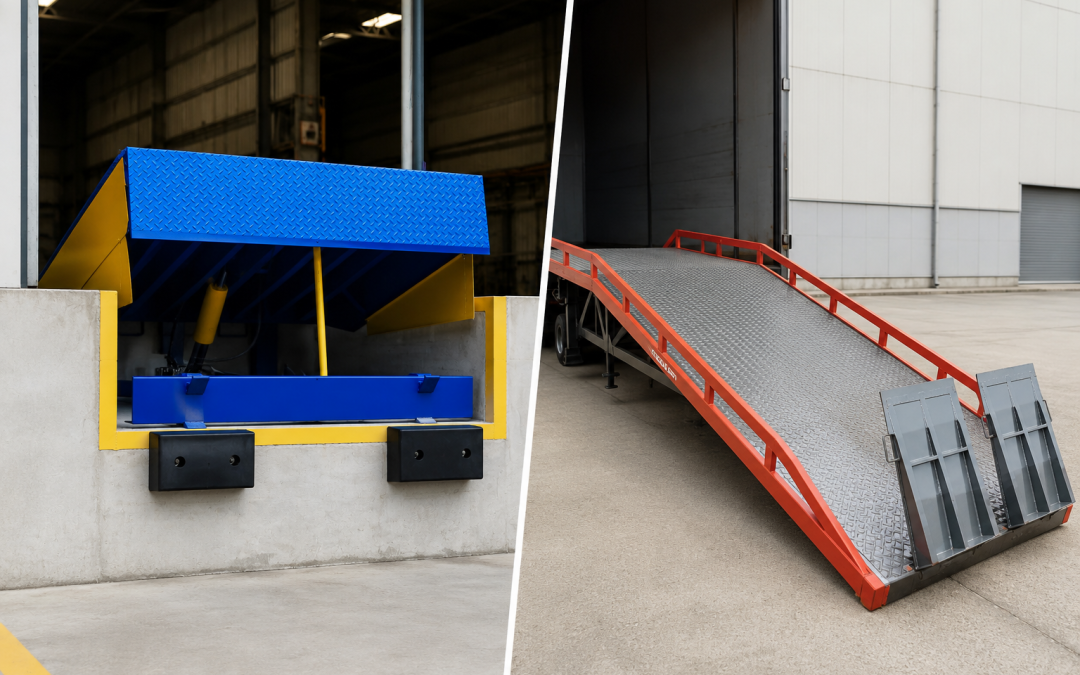
When it comes to improving loading and unloading operations, businesses often come across two common solutions: dock levellers and dock ramps. While both help bridge the height gap between a loading dock and a truck, they are designed for different applications.
Understanding the differences can help you choose the right solution for your warehouse, factory, or distribution centre.
What Is a Dock Leveller?
A dock leveller is a permanently installed loading bay solution that creates a smooth and safe bridge between the warehouse floor and the truck bed. It compensates for varying truck heights, allowing forklifts and pallet trucks to move goods efficiently.
Dock levellers are commonly installed in:
- Manufacturing facilities
- Distribution centres
- Logistics hubs
- Cold storage warehouses
- E-commerce fulfilment centres
What Is a Dock Ramp?
A dock ramp is a portable or movable loading solution that provides temporary access between the ground and a truck. Unlike dock levellers, dock ramps are not permanently installed and are suitable for locations without a loading dock.
Dock ramps are commonly used in:
- Small warehouses
- Temporary loading areas
- Outdoor operations
- Facilities with lower loading volumes
Dock Leveller vs Dock Ramp
| Feature | Dock Leveller | Dock Ramp |
|---|---|---|
| Installation | Permanently installed | Portable or movable |
| Operation | Hydraulic or mechanical | Manual or forklift-assisted |
| Loading Capacity | Suitable for frequent heavy-duty use | Suitable for light to medium-duty applications |
| Safety | Higher stability and safety | Depends on proper positioning |
| Productivity | Faster loading and unloading | Slower compared to dock levellers |
| Best For | Warehouses, factories, logistics centres | Temporary or occasional loading tasks |
Which One Is Better for Your Business?
The right choice depends on your operational requirements.
Choose a Dock Leveller if:
- Your facility has a dedicated loading bay.
- Loading and unloading are daily operations.
- You use forklifts regularly.
- You handle heavy or high-volume goods.
- You want to improve warehouse efficiency and safety.
Choose a Dock Ramp if:
- You don’t have a loading dock.
- Your loading activities are occasional.
- You need a portable solution.
- You require flexibility for different loading locations.
Why Many Warehouses Prefer Dock Levellers
For warehouses with high daily loading volumes, dock levellers offer several long-term advantages:
- Faster turnaround time for trucks
- Improved loading efficiency
- Enhanced workplace safety
- Reduced manual handling
- Better compatibility with forklifts
- Long-term durability for demanding operations
Although the initial investment may be higher than a dock ramp, many businesses find that dock levellers deliver greater value over time through improved productivity and reduced operational delays.
How to Choose the Right Loading Solution
Before deciding, consider the following:
- Do you have an existing loading dock?
- How often do you load and unload goods?
- What is the average weight of your loads?
- Will forklifts be used regularly?
- Is a permanent or portable solution more suitable?
Consulting an experienced supplier can help ensure you select the right equipment for your operational needs.
Conclusion
Both dock levellers and dock ramps play an important role in material handling, but they are designed for different environments. A dock ramp offers flexibility for temporary operations, while a dock leveller provides a safer, more efficient, and long-term solution for busy warehouses and factories.
If your business handles frequent loading and unloading, investing in the right dock leveller can improve productivity, reduce downtime, and create a safer working environment.
Disclaimer
We hope you found this article helpful and informative. Please note that the content provided is for general informational purposes only and should not be construed as professional advice. It may not reflect the full scope of services offered by Powertechnic Handling Equipment (M) Sdn. Bhd.
For tailored guidance, we strongly recommend consulting with a qualified industry professional. To receive expert advice and crane recommendations specific to your project requirements, please reach out directly to our team.
While we strive to ensure the accuracy and completeness of the information shared in our blog posts, Powertechnic Handling Equipment (M) Sdn. Bhd. makes no warranties and assumes no responsibility for any errors, omissions, or outcomes arising from the use of this content.