KEY INSIGHT: Why Switch to Overhead Cranes?
Even minor damage to a concrete component can cause costly rework or significant project delays. Because these elements are heavy yet structurally delicate before curing is complete, safe handling is essential. Overhead cranes provide controlled, stable movement, significantly reducing the risk of damage throughout production compared to mobile machinery.
Table of Contents
- Enhancing Safety on Site: The Risk of Makeshift Lifting
- Reducing Handling Errors with Controlled Movements
- Preventing Load Swing and Impact Damage
- Protecting Architectural and Finished Surfaces
- Enhancing Storage and Stacking Efficiency
- Common Types of Cranes for Precast Sites
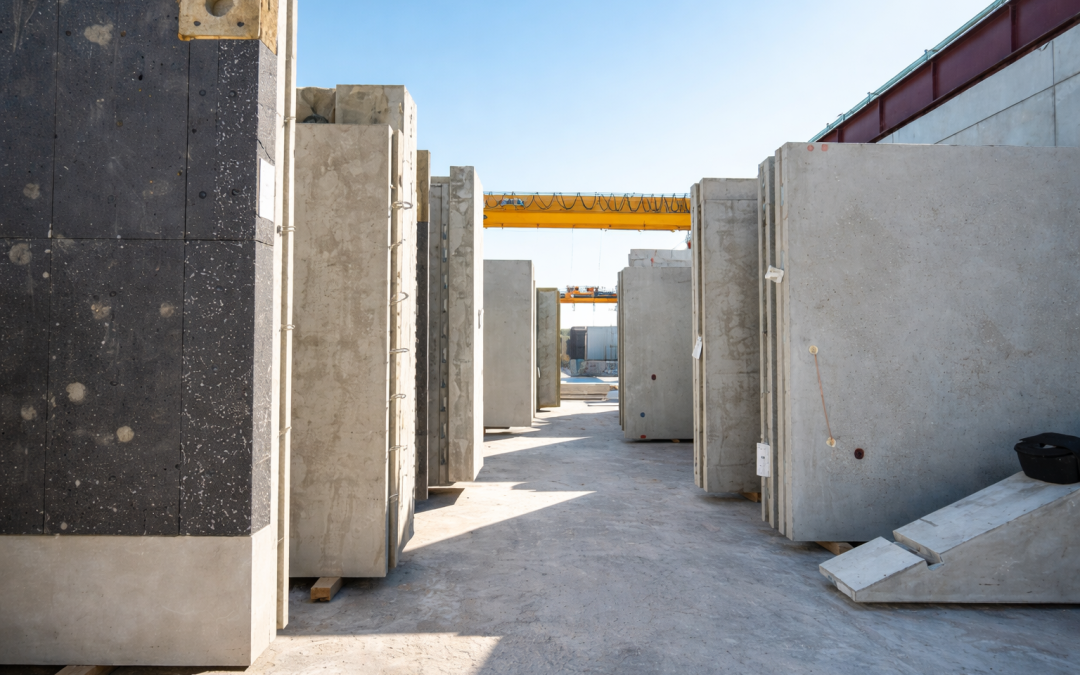
In precast concrete manufacturing, even minor damage can cause costly rework or delays. Because components are heavy and delicate, safe handling is essential. Overhead cranes provide controlled, stable movement, significantly reducing the risk of damage throughout production.
Enhancing Safety on Site
Tragically, accidents often occur when heavy precast elements are mishandled using equipment not designed for precision lifting.
A notable example occurred at McNair Road, Singapore, where a construction worker was fatally struck by a precast concrete drain channel being lifted at the site (The Straits Times, 2024).
This highlights the importance of:
- Using proper lifting equipment instead of makeshift methods
- Enforcing exclusion zones to keep workers clear of suspended loads
- Ensuring operator training and adherence to safety regulations like DOSH (JKKP) standards for safe lifting operations.
Overhead cranes, when correctly installed and operated, minimize the risk of accidents while protecting both workers and materials.
Reducing Handling Errors with Controlled Movements
Unlike forklifts or manual lifting equipment, overhead cranes offer:
- Smooth vertical and horizontal movement
- Greater control over lifting speeds
- Precision placement of molds, reinforcement, and final products
This level of control minimizes sudden jerks or unstable motions that can cause cracks, chips, or surface damage to precast elements.
Preventing Load Swing and Impact Damage
Load swing is one of the biggest contributors to accidental impact damage in precast facilities.
Modern overhead cranes address this by offering:
- Anti-sway technology
- Variable-frequency drives (VFDs) for smooth acceleration and deceleration
- Synchronized controls for multiple hoists or dual lifting points
These features ensure that large precast components remain stable during movement, protecting edges, corners, and embedded components.
Protecting Architectural and Finished Surfaces
Precast components with architectural finishes—such as polished concrete, textured surfaces, or colored panels—require extra care.
Overhead cranes help protect these surfaces by:
- Using gentle lifting motions that avoid scratching
- Allowing non-contact transportation, protecting finishes from forklift tines or ground debris
- Supporting custom lifting attachments that grip components securely without damaging finishes
Consistent, controlled handling ensures that decorative elements remain intact from production to installation.
Enhancing Storage and Stacking Efficiency
Damage can also occur when precast components are set down or stacked incorrectly.
Overhead cranes:
- Enable precise placement in tight storage areas
- Reduce the risk of dropping or misalignment
- Support proper orientation to maintain structural integrity
- Allow safe stacking angles for panels or double-tee beams
Optimal storage handling keeps products organized and damage-free.
Common Types of Overhead Cranes Used in Precast Concrete Sites
1. Gantry Cranes
- Structure: A bridge supported by legs that run on ground rails, not fixed runways.
- Use in Precast: Common in outdoor storage yards or when the building structure cannot support an overhead bridge crane. Offers mobility and flexibility.
2. Semi-Gantry Cranes
- Structure: One end runs on a runway rail; the other end moves on the ground.
- Use in Precast: Useful for partially covered areas or mixed indoor/outdoor operations.
3. Single-Girder Overhead Cranes
- Structure: One main girder supported by end trucks that run on runway rails.
- Use in Precast: Ideal for smaller precast components or facilities with limited space. Offers easy installation and lower cost.
4. Double-Girder Overhead Cranes
- Structure: Two main girders with a hoist traveling between them.
- Use in Precast: Preferred for large beams, wall panels, and other heavy precast elements. Provides higher hook lift and more stability.
Overhead cranes are more than just lifting equipment. They are essential for quality control, safety, and efficiency in precast operations. By reducing material damage, protecting finished surfaces, and minimizing risk to workers, cranes help manufacturers save time, cut costs, and deliver reliable products.
Ready to Upgrade Your Precast Facility?
Don’t risk costly rework or workplace accidents with outdated lifting methods. Contact Powertechnic today for a site assessment. Our engineers will help you design a custom overhead or gantry crane system that maximizes safety and protects your precast quality.
REFERENCES
The Straits Times. Construction worker dies after being struck by precast concrete at McNair Rd worksite. 2024. Available at: https://www.straitstimes.com/singapore/construction-worker-dies-after-being-struck-by-concrete-drain-channel-at-mcnair-road-worksite
Disclaimer
We hope you found this article helpful and informative. Please note that the content provided is for general informational purposes only and should not be construed as professional advice. It may not reflect the full scope of services offered by Powertechnic Handling Equipment (M) Sdn. Bhd.
For tailored guidance, we strongly recommend consulting with a qualified industry professional. To receive expert advice and crane recommendations specific to your project requirements, please reach out directly to our team.
While we strive to ensure the accuracy and completeness of the information shared in our blog posts, Powertechnic Handling Equipment (M) Sdn. Bhd. makes no warranties and assumes no responsibility for any errors, omissions, or outcomes arising from the use of this content.